
The relevance of the prosthetic foot
The prosthetic foot is the foundation of your prosthesis, influencing overall comfort, performance and mobility. Ottobock offers a wide range of prosthetic feet, from carbon-fibre to microprocessor-controlled options.
The prosthetic foot is the foundation of your prosthesis, influencing overall comfort, performance and mobility. Ottobock offers a wide range of prosthetic feet, from carbon-fibre to microprocessor-controlled options.
Together with your O&P professional, find the right solution for your needs and lifestyle. Contact us to learn more and find the right prosthetic foot for you.
How you and your O&P professional select the right prosthetic foot
Please note: Choosing a prosthetic foot that best suits your personal requirements, needs and goals is a complex task. Your O&P professional is an expert in this field. Thanks to his education, experience and biomechanical knowledge, he will choose the prosthetic foot that helps achieve the best possible fitting outcome for you individually. The information provided in this section only serve as a guidance. Please contact your O&P professional if you have more detailed questions.
Personal factors
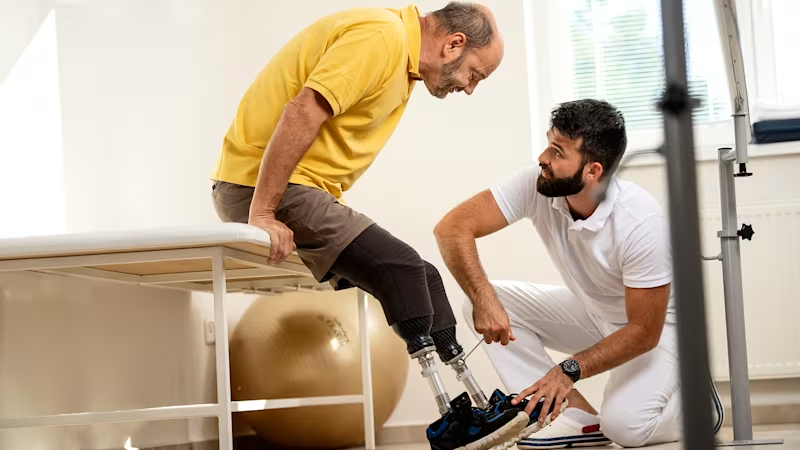
Apart from all the technical selection criteria, your O&P professional will keep in mind your personal needs, living situation and goals when choosing the foot prosthesis. These factors might be the desire to participate in sports activities or the ability to paint your toenails. These are of great importance because your prosthetic foot should be like an extension of yourself.
Amputation level
Your amputation level will be one of the first things that needs to be looked at when chosing the components in your prosthesis. An above knee amputation requires a prosthetic knee joint and the type of knee joint will help to define the appropriate prosthetic foot. This is where your O&P professional will assess the functions of the prosthetic knee joint and recommend an appropriate prosthetic foot. Because the natural knee joint is intact after a below knee amputation, your O&P professional will consider factors like length of the residual limb, strength and range of motion when recommending an appropriate foot prosthesis.

Activity level
Manufacturers categorise prosthetic feet by the user’s activity level – also called mobility grade. This means that not every prosthetic foot can be used by every user. Selecting a prosthesis that matches your activity level will maximise your mobility and your quality of life. Here are some very basic indications for identifying your activity level. If you are on the border between two activity levels, your O&P professional will consider multiple products to assess the one that is best for you.

Build height
Prosthetic feet vary in height. We call the height of a prosthetic foot build height. Your height and the length of your residual limb as a below knee amputee will determine the space you have for a prosthetic foot and what is the appropriate build height for the prosthetic foot. As an above knee amputee, the length of the prosthetic knee joint will be an additional factor to consider for the build height of the prosthetic foot.

Body weight
Prosthetic feet are designed for a specific weight range. To ensure that a prosthetic foot performs well for you, your O&P professional will choose one suited to your weight class.
Foot size
Like human feet, prosthetic feet differ in length and size. Prosthetic feet are sized by cm rather than standard shoe sizes. Every foot is available in a specific range of sizes. There are prosthetic feet that come in sizes for children while others are even sized for large adults. Ottobock running blades and specialty sports feet often have a a single size.
Specific information about prosthetic feet
Comfort
A foot prosthesis has to feel good for you to meet your activity goals.


Contact Ottobock
Do you want to know more about Ottobock prosthetic feet? Please fill out the form - We look forward to supporting you on your way to more mobility.