


Noah Elliott’s Journey From Local Skatepark to The Paralympic Slopes
During the snowboarding off-season, our own Aaron Holm, Head of Consumer Engagement for Ottobock North America, had a chance to catch up with 3x Paralympian and now 4x Paralympic medalist Noah Elliott at our HQ here in Austin, TX.
The two chatted about how Noah got started with snowboarding after going through his amputation procedure, how he prepares for events as a world-class athlete, and the importance of spreading the stoke so future generations can carry the torch.
Without further ado, let’s get into the conversation.
How it started
Aaron: Noah is a Paralympic snowboarder. Tell me how you got into it, first of all, going way back.
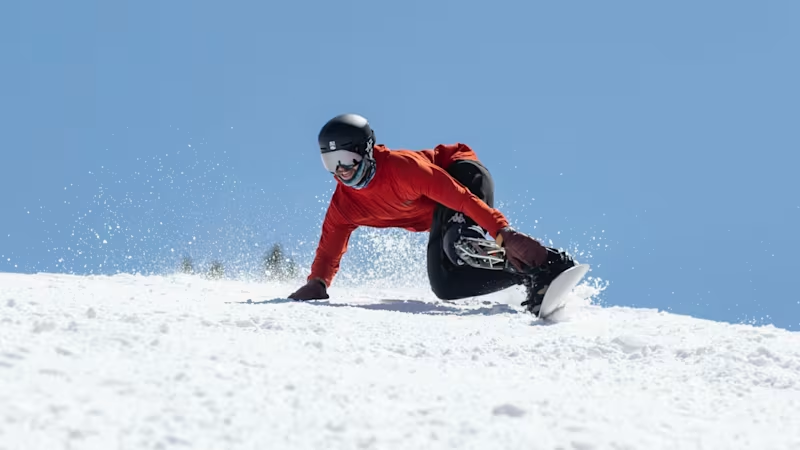
Noah: Yeah, we all know about the Paralympics hopefully at this point. If you don’t, it’s an amazing sporting event similar to the Olympics for disabled people and athletes. And for myself I got my disability when I was diagnosed with cancer in 2013. I had osteosarcoma bone cancer in my leg.
That later led to me getting the amputation, so my discovery of the Paralympics and getting involved in the community kind of set this goal for me to become a Paralympic snowboarder and represent Team USA.
Getting involved
Aaron: Let’s go back to the beginning of snowboarding. How did you get involved?
Noah: I got involved because I was lucky enough to be surrounded by a team of nurses that genuinely cared. They all care, right? But they actually went a step above and beyond and said, “Hey, Noah, we know you lost skateboarding because you’re here in the hospital going through chemotherapy and fighting your battle, but here’s something I think would be cool for you to watch.” And that was the Paralympics.
I got lucky enough that NBC decided to up the coverage of the Paralympics, which is huge, and because of that I was able to watch it from St. Louis and cast this dream of becoming a professional snowboarder one day.
The impact of community
Aaron: I love that part of the story where you were in the hospital, and one of your caregivers said, “You gotta check this out.”
Noah: Exactly. And that right there shows that community that we’re involved in how impactful it can be to have this awareness and get it out there so people know.
I was very lucky to be sitting in the hospital and have a nurse who was like, “Man, you’re gonna love this. I know you.” We turned on the Paralympics, and I got to watch the Paralympics on TV debut snowboarding.
Aaron: And you had never snowboarded? You’re a skateboarder, and you thought, “Ok it makes sense, right?” You’ve got your foot locked into the board, and it’s probably easier than skateboarding?
Noah: Exactly. And that’s exactly the way I saw it, right? I skateboarded growing up in the Midwest and never thought I’d be a professional snowboarder, but even despite the disability and going through cancer I looked at snowboarding and said, “Well, I have a prosthetic now. My foot’s strapped to the board; it seems like it would be a little easier.”
Paralympics prep
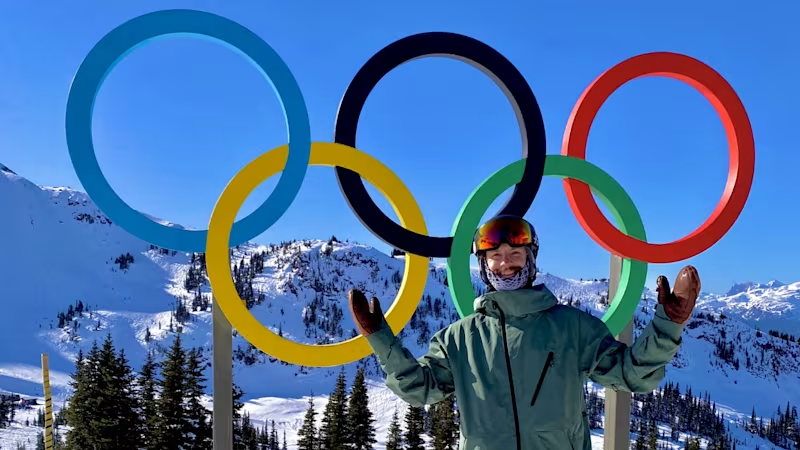
Aaron: Speaking of the Winter Games, how do you get ready for the Winter Games? What are you doing during the downtime, the summer months, when you don’t have a real good opportunity to train?
Noah: I actually do a lot of dry-land training, whether it’s getting stronger in the gym, getting back on the skateboard trying to do some cross training in a skatepark, or even if it’s just downtime with my family. Ya know, spending time with my girlfriend and my daughter or visiting my family back home in St. Louis. Those are the things that are really able to keep me motivated and inspire me to continue to do what I do over the years.
It can be a lot going from when the season starts in November until the end of the season. And we’re traveling internationally all over for multiple competitions, and it can be a strain.
So that’s my summer. I take that time for Noah Time, and it’s a great opportunity to be here and also share a little more about the Paralympics, right? Not everyone realizes how competitive the Paralympic Games are. We go through the same qualifying process as the Olympics do, so it’s a competitive process and it keeps it exciting.
Competitive disciplines
Aaron: Talk a little bit about the competitions in snowboarding. Banked slalom? Snow cross? I’m going to stop there. [laughs]
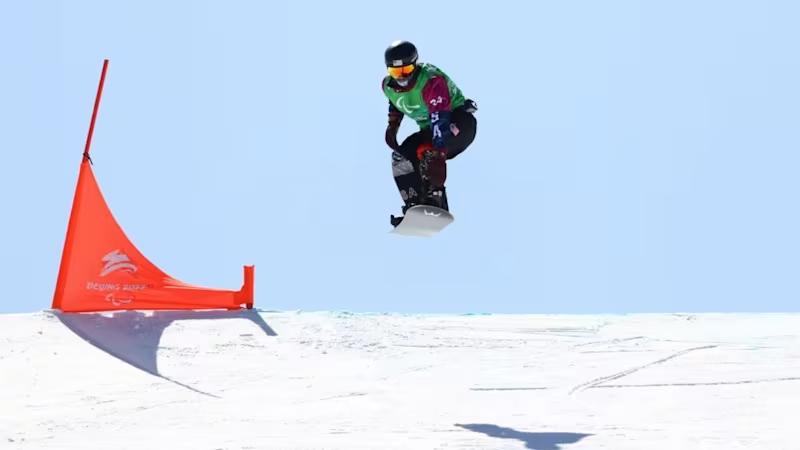
Noah: No, that’s great! So we have two disciplines that we compete in in Paralympic snowboarding… snowboard cross and banked slalom.
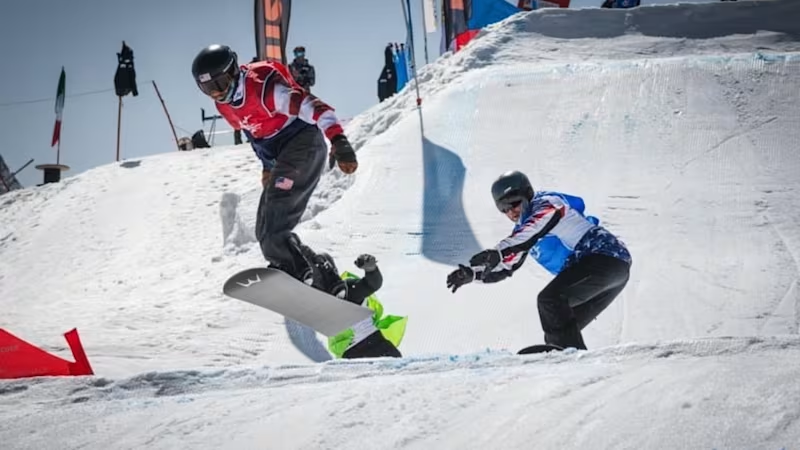
Snowboard cross is essentially motocross but built out of snow features. We actually race head-to-head, four people at a time lined up at a gate. They drop the gate, all the racers come out, and it’s a bracket system. Top two to cross the finish line advance, and they do that through big and small finals, which is 1st through 4th place and 5th through 8th place.
So, to me, going into a race day my goal is to be top two all the way through boarder cross to the end and hopefully win—be the first one to cross that finish line.
And banked slalom is actually a race against the clock, so you’re competing against yourself. You get on there, there’s a timer that goes off, and the person down the fastest wins.
All things equipment
Aaron: What about equipment? Do you want to talk about equipment a little bit? What you’re using and are you using the same prostheses for your activities, the daily living, your traveling than you are on the slope? I’m assuming it’s something different.
Noah: That’s a great assumption, and not everyone might know that. Just as a runner or a track athlete or even a soccer player, right? You might have cleats. And you wear your cleats when you’re playing the game, and you wear regular tennis shoes when you’re walking around.
Someone with a medical device—if you’re doing anything athletic—you might need a better wheelchair or you might need a different piece of equipment. So for me, I’m a daily user of the Ottobock Genium X3. Very luck to have this piece of equipment. It’s fantastic; it gives me a lot of opportunities like allowing me to ride a motorcycle, which is pretty cool.
Outside of that, I do have different needs for snowboarding, and that’s why it’s important to have an adaptive piece of equipment for sports.
Aaron: Yeah, you know, something that has a little bit more of a vertical shock.
Noah: Exactly. So [the Genium] is meant for walking and having the pendulum in motion vs. my snowboarding leg is actually more vertical, dynamic up-and-down movement.
Weather conditions
Aaron: Noah does the majority of his training in Colorado, and then I know you’re leaving for overseas tomorrow over in Argentina and then you’re gonna be competing in Italy. How do you compete, because the elements are different?
You’re competing in powdery conditions—low 30’s, high 20’s, something like that—and then you go over to Italy in a few months and it’s a completely different world over there.
Noah: Absolutely. And that’s one of the cool things about winter sports is your subject to the elements at all times. For winter sports and winter athletes we really see that impact, right? You could have a day where it’s beautiful sunshine and blue birds, and the snow is perfect.
Then you could have days where you’re out there and it’s snowing and it’s a blizzard and you still have to compete through that weather where you can barely see your hand in front of your face. So there’s definitely challenges that brings, and it keeps us on our toes. And it even makes it different for some of the settings I might play with on my prosthetic.
Women’s snowboarding and media representation
Aaron: We gotta talk a little bit about the women’s snowboarding team. Well, we don’t have to talk a little, we have to talk a lot about it because we know so many people that are on that team, that are involved, and that are pushing and promoting growth. How do we encourage the next generation to get involved and to get out there?
Noah: Yeah, that’s exactly the point. We have a newly made sport. 2014 it made its debut in the Paralympics. Since then it’s grown a ton, and I think the biggest thing is getting the money and programs to develop and get the word out there.
We have a great female team for snowboarding, then the games happen, people retire, and unfortunately up until this point we haven’t had a lot of up-and-coming females. So any girls that out there that have snowboarded before, skateboarded, surfed, any board sport, or really just wanted to try it—get out there, get involved, you can reach out.
There’s plenty of opportunity to reach out to any of the Paralympians on the team if you’re interested, and we’d love to get you out on the snow and figure it out because that’s what we need to continue to grow.

Media representation
Aaron: So, Noah, you mentioned media representation the year that you were in the hospital and you discovered this incredible sport that’s completely embraced you and you’ve embraced it. How has media representation with streaming and live coverage changed even in the last 10 years since you’ve engaged?
Noah: I was very fortunate that they decided with NBC and the Paralympic movement to up the coverage, and now it’s come full circle and I get to have that opportunity to showcase our sport on the world stage and help get more coverage.
At the end of the day, that is the essence of building our sport and our community. It’s so, so important. I’m from St. Louis, Missouri, not in the mountains at all, and I became a professional snowboarder.
And that shows the power of life after living with a disability, either you have an accident or even if you’re born that way it’s still important to realize there’s opportunities out there. But you don’t know if you don’t know, so the coverage is important for the future of our sport.
Where to look next
Aaron: Now, if someone’s out there [reading] this, a kid that is a skateboarder or even a little athlete that wants go beyond what they’re currently doing right now, where do they go? Where do they look for resources to take that first run down the slopes?
Noah: Thankfully we’re in a place that has a lot of different opportunities, and it’s continuing to grow, and the work we are seeing at Ottobock is a big contributing factor to that. The biggest thing is, I would say, do some research depending on what sport you are in. You will be able to find something.
There are a lot of great non-profits out there that can help people—either new to a disability or somebody that lives with a disability and just wants to get involved. There’s organizations like Wiggle Your Toes, there’s opportunities with the National Ability Center in Park City, UT. There’s even Disabled Sports USA (now Move United), but you can look into those avenues and hopefully get a grant, get involved, and figure out where to start.
Aaron: We do a lot of clinics as well that are really good at getting people out that just wanna try to see if it’s for them.
Noah: Yeah, and that goes a long way—recreating or competing internationally on the Paralympic team. No matter what it is for you, there’s definitely an opportunity to get out there, get involved with a clinic like you said, and give it a shot.
The start of your Paralympic journey?
Well, there you have it, folks. You never know what might happen when you’re in the right place at the right time.
For Noah, the right place also happened to be the most challenging experience of his life, but from that time of uncertainty came true purpose, the pursuit of world-class greatness, and the opportunity to share that with so many other people around the world.
If you’re inspired by Noah’s story (or know someone who might be), please share it so more people can take a page out of Noah’s book and pursue their dreams—even if those dreams have yet to be discovered.