

Ezra Frech’s Journey from Dreamer to Double Paralympic Champion
When Ezra Frech declared at age 11 that he’d one day compete in the Paralympic Games, it sounded like a childhood fantasy, the kind of lofty ambition reserved for dreamers. But for Ezra, dreaming big has never been optional. It’s how he lives. And at just 19, the world has already seen what happens when you mix relentless drive with unshakable belief.
Today, Ezra is not just a two-time Paralympic gold medalist. He’s a rising college athlete at USC, a changemaker in the adaptive sports world, and a beacon of inspiration for young athletes with disabilities. But his path has been anything but linear. It’s been shaped by rain-soaked disappointments, unexpected wins, and a community that’s been cheering him on since he was just a toddler sprinting across SoCal adaptive sports fields.
From Nine Events to Narrow Focus
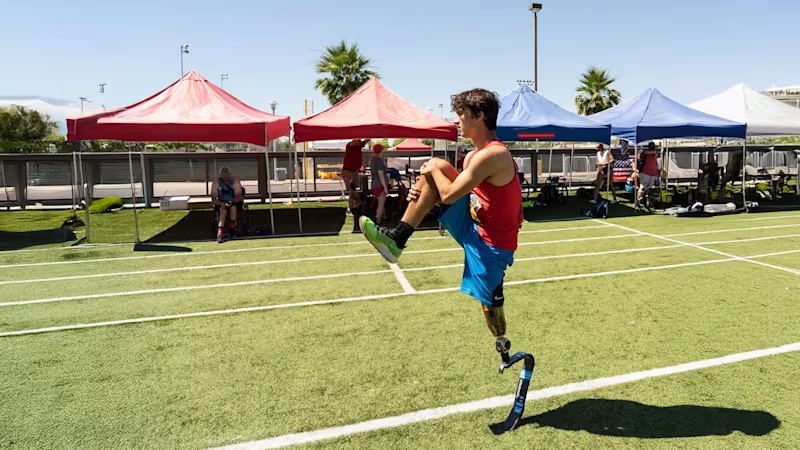
Ezra’s introduction to adaptive sports came early, at five months old, to be exact. His parents were already immersed in the community, and by age eight, Ezra was competing in every event his dad could sign him up for: sprints, jumps, throws, you name it. “I would complain and cry that it was too much,” he admits now with a laugh. “But the cool thing is that after years of doing all of these events, I found the ones I really loved.”
That early exploration helped Ezra home in on his true athletic passions: 100 meters, long jump, and high jump. Ironically, these are the exact three events that are part of the Paralympics. Watching mentors and friends compete at the Rio 2016 Games lit the match. “I made a commitment then and there to train for Tokyo 2020,” he recalls. “I was 11. Just a kid saying he was going to the NBA or to space.”
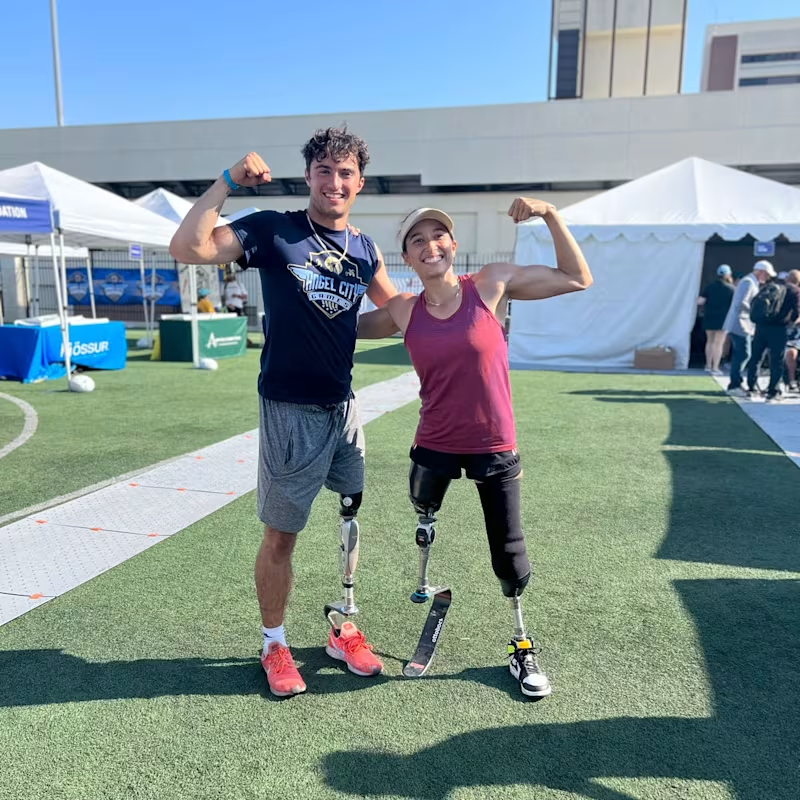
By 14, Ezra’s dream became real. He qualified for Team USA at the Angel City Games, a flagship event created by his own family’s nonprofit, Angel City Sports, earning the spot on his home track at UCLA in front of friends and family. “It was a pretty epic moment,” he says. “2019 was my breakout year.” He went on to medal at the Junior World Para Athletics Championships and the Parapan American Games and made finals in all three events at the World Championships, the youngest athlete there out of 1,400.
Tokyo, Paris, and the Power of Redemption
Ezra a fait partie de l’équipe paralympique de Tokyo, mais a dû faire face à une énorme déception. Combattant la pluie et la pression lors des finales de saut en hauteur, il a raté le podium d’un pouce seulement. "J’ai beaucoup appris, surtout comment gérer l’échec," dit-il.
Mais les champions ne sont pas définis par l’or; ils sont définis par ce qu’ils font après avoir perdu.
En 2023, Ezra est revenu en rugissant pour remporter son premier titre de champion du monde. Puis vint l’année 2024 et une perte surprenante de ce même titre, à peine quatre mois avant les Jeux paralympiques de Paris. "Mon entraîneur et moi nous sommes attachés cet été-là," dit Ezra. "Et j’ai eu la chance de remporter la médaille d’or au 100M et au saut en hauteur."
La victoire du 100M a été particulièrement significative. "Tout à fait inattendu. J’étais classé 7ème au monde. Mes concurrents ne pouvaient pas croire que j’avais gagné." Il a consacré 100 jours sur les réseaux sociaux à compter à rebours jusqu’à son moment de rédemption à Paris. Cette fois, il n’était pas seul. "Contrairement à Tokyo, j’ai pu avoir ma famille, mes amis et ma communauté dans les tribunes. Paris sera toujours dans mon cœur."
A Lifelong Partnership with Ottobock
Ezra’s journey has been bolstered by a deep partnership with Ottobock, one that began when he was just six or seven years old. “I’ve been on Ottobock products my whole life,” he says. “Now, I’m proud to be their first Global Ambassador from North America.”
One key figure in that journey was Paralympic legend Heinrich Popow, who mentored Ezra and later helped refine his prosthetic setup leading into Paris. “Winning those golds wasn’tjust about me, it was about the team behind me. My friends at Ottobock have been with me every step.”
What Drives a Champion?
Ezra doesn’t hesitate when asked what fuels his fire. “I want to normalize disability and inspire the world to dream,” he says. “I want to build my brand and business so I can donate more to Angel City Sports. I’m not short on motivation.”
His daily life reflects that drive. A freshman at USC, Ezra balances college coursework with intense training, mentoring athletes, and creating content to share his story with the world. “I’m the first above-knee amputee to be recruited to a Division I track team,” he says. “I want to show what’s possible.”
He’s also producing a new documentary series, set to release on NBC Peacock, and training for a packed competition calendar leading up to the Los Angeles 2028 Paralympic Games.
Lessons for the Next Generation
For Ezra, success isn’t measured in medals. It’s about the pursuit. “It’s not about achieving your goals. It’s about the sacrifice, the process, the passion,” he says. “Set unattainably high goals and chase them with everything you’ve got.”
His advice for others living with disabilities is grounded in community and courage. “You don’t have to care about the Paralympics to join adaptive sports,” he says. “Do it for your soul. Sport can change lives.”
Ezra encourages everyone to build a lifelong support team, dream boldly, and give back. “Be of service,” he adds. “You can be a mentor. A light. We need you.”
Eyes on the Future
Ezra is optimistic about where Paralympic track and field is headed, especially with growing integration into mainstream events like USATF Nationals. But he knows there’s work to be done. “Most Americans don’t even know what the Paralympics are,” he says. “With LA28, that can change. We can reframe how the world sees disability.”
He also hopes for continued advancements in prosthetic technology. “Our world record in the 100M is 11.95 seconds. I ran a 12.06. I believe we’ll see an above-knee athlete break 11, maybe even 10 seconds one day. With the right training, support, and innovation, it’s possible.”
“Walk in Like You Own the Place”
If there’s one person Ezra credits most, it’s his mom. “She’s poured her heart into me,” he says. “She told me, ‘Stick your head up, chin out, shoulders back. Walk in like you own the place.’ That advice gave me confidence before I even had medals to prove it.”
Today, Ezra Frech walks into every room—and every race—like he owns it. And with each stride, jump, and finish-line burst, he’s not just chasing gold. He’s changing what the world believes is possible.