
Discover C-Brace.
Key Highlights of the C-Brace.
Unparalleled Innovation
As the only intuitive Knee-Ankle-Foot Orthosis (KAFO) of its kind, the C-Brace stands out from alternatives that require more effort and manual intervention for daily use.
As the only intuitive Knee-Ankle-Foot Orthosis (KAFO) of its kind, the C-Brace stands out from alternatives that require more effort and manual intervention for daily use.
Adaptive and Responsive
The C-Brace uniquely learns and adapts to your patients' movements, offering unmatched stability and confidence in their everyday activities.
The C-Brace uniquely learns and adapts to your patients' movements, offering unmatched stability and confidence in their everyday activities.
Hands-Free Mobility
With its groundbreaking technology, the C-Brace allows users complete hands-free mobility across various actions - be it walking, sitting, standing, or navigating stairs and ramps.
With its groundbreaking technology, the C-Brace allows users complete hands-free mobility across various actions - be it walking, sitting, standing, or navigating stairs and ramps.
Empirical Evidence of Efficacy.
Enhanced Balance: Users experienced a notable 20% improvement in balance with the C-Brace, compared to conventional KAFOs.
Substantial Fall Reduction: A significant 73% decrease in falls was observed, markedly reducing users' fear of falling.
Quality of Life Improvements: Participants reported marked enhancements in 5 out of 9 quality of life areas, including a 50% increase in Physical Functioning, as per the global quality of life assessment.
Reduced Dependence on Walking Aids: The study noted a considerable decrease in the need for walking aids during everyday activities.
Tailored for Individual Needs
Each C-Brace is meticulously crafted to fit the unique anatomical requirements and specific conditions of the patient. This personalized approach ensures an optimal fit and function, involving several steps for evaluation and fitting for each potential user.
Each C-Brace is meticulously crafted to fit the unique anatomical requirements and specific conditions of the patient. This personalized approach ensures an optimal fit and function, involving several steps for evaluation and fitting for each potential user.
Identifying Suitable Candidates
Our comprehensive list of indications assists in pinpointing the ideal candidates for the C-Brace. If you have a patient who might benefit from this innovative orthosis, please use the link below to request more information and arrange an in-person demo.
Our comprehensive list of indications assists in pinpointing the ideal candidates for the C-Brace. If you have a patient who might benefit from this innovative orthosis, please use the link below to request more information and arrange an in-person demo.
For Medical Professionals
If you're a healthcare professional seeking detailed information, please complete the form below and a dedicated Ottobock representative will contact you to provide personalized assistance.
If you're a healthcare professional seeking detailed information, please complete the form below and a dedicated Ottobock representative will contact you to provide personalized assistance.
Who is the C-Brace for?
Cognitive requirements
The patient must be capable of ensuring the proper handling, care, and use of the orthosis (e.g. charging the battery, operating the user app, etc.)
Functional deficit
Neuromuscular or orthopedic instability of the knee joint in the sagittal plane diagnosis (by the physician)
Has one or more of the following conditions:
Quadricep weakness
Charcot Marie Tooth Syndrome (CMT)
Multiple Sclerosis
Polio
Spinal Cord Injury
Hip/Knee/Ankle Injury
Guillain-Barre Syndrome
Stroke victim
Deep vein thrombosis (DVT)
Paraplegic
Chronic inflammatory demyelinating polyneuropathy (CIDP)
Transverse/Partial Myelitis
Neuro Lyme Disease
Fibromyalgia
Osteogenesis Imperfecta
Ehlers Danlos Syndrome
Disclaimer: Not all people with one or more of these conditions will be a candidate for C-Brace but should still be considered.
Indications.
The C-Brace may be considered for patients with all neurologic conditions resulting in paresis or paralysis of the knee extensors, or orthopedic conditions in which the quadriceps fail to keep the knee extended during stance phase who do not present any of the contraindications. The leading indications are incomplete paraplegia with very minor or no spasticity, as well as post-polio syndrome, the condition following poliomyelitis.
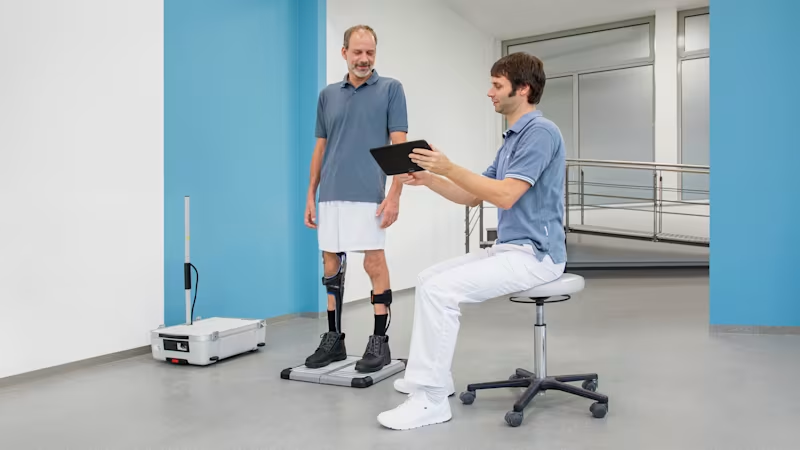
Other Factors to Consider.
The patient must be able to fully stabilize their torso.
The muscle strength of their hip extensors and flexors must permit controlled swing-through of the affected leg.
Compensatory hip movement is permissible.
The patient must fulfill the physical and mental requirements for perceiving optical/acoustic signals and/or mechanical vibrations.
Contraindications
Inability to advance the limb through compensatory motion or grade 3 hip flexor
Insufficient trunk stability
Moderate to severe spasticity
A flexion contraction of more than 10° in the knee and/or hip joint
Genu varus/valgus of more than 10° that cannot be corrected
Body weight > 275 lbs.
Leg length discrepancy > 6 in.
Physician Reference Guide
C-Brace Leg Orthosis: Therapy exercises 1/16 - Introduction
This video gives an overview about the following videos regarding physiotherapy and gaittraining with the C-Brace orthotic system. It can be used as an orientation in the conception of an exercise program for users.
This video gives an overview about the following videos regarding physiotherapy and gaittraining with the C-Brace orthotic system. It can be used as an orientation in the conception of an exercise program for users.
Wolfgang's life with the new C-Brace
Wolfgang has polio and post-polio syndrome; his right leg is paralyzed. Recently he was supplied with the new C-Brace. He describes how it improves his gait pattern and supports him especially in stumbling situations.
Wolfgang has polio and post-polio syndrome; his right leg is paralyzed. Recently he was supplied with the new C-Brace. He describes how it improves his gait pattern and supports him especially in stumbling situations.
Melvin's life with the new C-Brace
Melvin has polio, which partially paralyzes his left leg. He tells how he was supplied with the new C-Brace and how it supports him in his active life.
Melvin has polio, which partially paralyzes his left leg. He tells how he was supplied with the new C-Brace and how it supports him in his active life.
David C-Brace Gait Comparison
David compares gait with and without the C-Brace.
David compares gait with and without the C-Brace.
Denise C-Brace Gait Comparison
Denise compares walking with and without C-Brace.
Denise compares walking with and without C-Brace.
Heike C-Brace Gait Comparison
Heike compares walking with and without the C-Brace.
Heike compares walking with and without the C-Brace.
Melvin C-Brace Gait Comparison
Melvin compares walking with and without the C-Brace.
Melvin compares walking with and without the C-Brace.
Rebecca C-Brace Gait Comparison
Rebecca compares walking with and without the C-Brace.
Rebecca compares walking with and without the C-Brace.